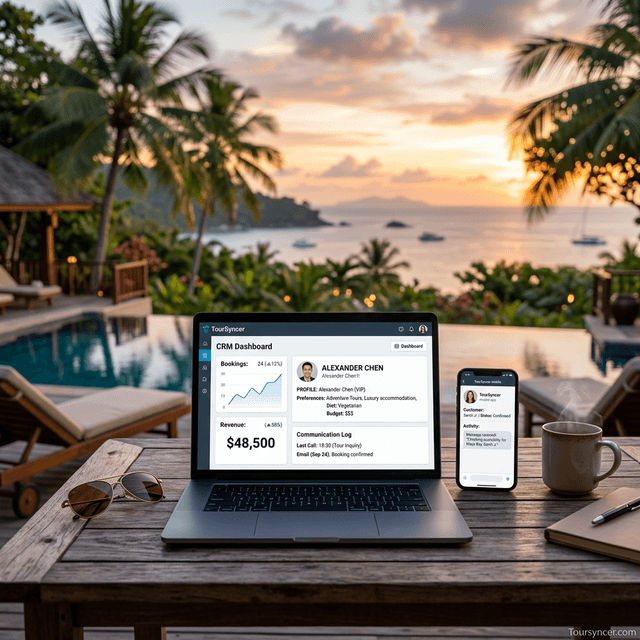
Discover the top 10 CRM systems built for tour operators in 2026. Compare features, pricing, and integrations to find the perfect CRM for your tour business, from all-in-one platforms like TourSyncer to standalone tools like HubSpot and Salesforce.
Why Tour Operators Need a Dedicated CRM
Running a tour operation is unlike any other business. You are not just selling a product off the shelf -- you are coordinating complex, multi-day experiences that involve suppliers, guides, transport, accommodation, and dozens of moving parts. A generic spreadsheet or shared inbox simply cannot keep up.
A CRM (Customer Relationship Management) system purpose-built for, or well-adapted to, tour operations gives you a central place to:
- Track every customer interaction from the first enquiry through to a glowing post-trip review.
- Manage bookings and reservations without double-entering data across systems.
- Automate follow-ups and reminders so no lead slips through the cracks.
- Segment your audience for targeted marketing campaigns and repeat-booking offers.
- Forecast revenue with pipeline visibility across upcoming departures.
Without a CRM, tour operators rely on fragmented tools -- a booking system here, an email tool there, a spreadsheet for finances -- and that fragmentation costs time, money, and customers. According to industry research, businesses that adopt a CRM see an average 29% increase in sales and a 34% improvement in customer satisfaction.
The question is not whether you need a CRM, but which one fits your tour business best.
Key CRM Features Every Tour Operator Should Look For
Before diving into the comparison, here are the essential features you should evaluate:
1. Contact and Lead Management
Store detailed guest profiles, track past trips, record dietary requirements, passport details, and special requests. The CRM should make it easy to convert enquiries into confirmed bookings.
2. Booking and Reservation Integration
The best CRMs for tour operators connect directly with your booking engine so you are not copying data between systems.
3. Pipeline and Sales Tracking
Visual pipelines let you see exactly how many leads are at each stage -- enquiry, quote sent, deposit paid, fully confirmed -- and forecast revenue accordingly.
4. Automated Communication
Email sequences, SMS reminders, pre-trip information packs, and post-trip feedback requests should all be automatable from the CRM.
5. Reporting and Analytics
Dashboards showing booking trends, revenue by tour type, customer lifetime value, and marketing ROI are essential for growth.
6. Mobile Access
Tour operators and guides are often on the road. A CRM with mobile app access is critical.
7. Integration Ecosystem
Your CRM should connect with payment gateways (Stripe, PayPal), email marketing tools, accounting software, and channel managers.
Why an All-in-One Solution Beats a Standalone CRM
Here is the fundamental challenge with using a standalone CRM for your tour operation: it is only one piece of the puzzle.
If you pick HubSpot for CRM, you still need a separate booking system, a separate itinerary builder, a separate invoicing tool, and a separate channel manager. Each of these tools has its own subscription fee, its own login, and its own data silo. Syncing them requires expensive middleware or constant manual effort.
An all-in-one tour operator platform like TourSyncer includes a built-in CRM alongside booking management, itinerary building, invoicing, staff scheduling, supplier management, and even a white-label mobile app. Everything lives in one place. Every booking automatically updates the CRM. Every invoice is linked to the right customer. Every guide has access to the right trip details.
The result? Less time on admin, fewer errors, and a significantly lower total cost of ownership.
Quick Comparison Table
| CRM Solution | Best For | Tour-Specific Features | Starting Price | Our Rating |
|---|---|---|---|---|
| TourSyncer | All-in-one tour management | Built-in CRM, bookings, itineraries, invoicing | Free tier available | 5/5 |
| HubSpot CRM | Marketing-heavy operators | None (needs customisation) | Free (limited) | 4/5 |
| Salesforce | Enterprise tour companies | Via AppExchange add-ons | $25/user/mo | 3.5/5 |
| Pipedrive | Sales-focused teams | None (pipeline focused) | $14/user/mo | 3.5/5 |
| Zoho CRM | Budget-conscious operators | Limited (via Zoho ecosystem) | Free (3 users) | 3.5/5 |
| Monday.com | Project-heavy operations | None (project management focus) | $9/seat/mo | 3/5 |
| Freshsales | Small to mid-sized operators | None (general SMB) | Free (limited) | 3/5 |
| Capsule CRM | Simple, travel-friendly use | Basic travel integrations | $18/user/mo | 3/5 |
| Less Annoying CRM | Budget-first operators | None | $15/user/mo | 2.5/5 |
| Insightly | Integration-heavy workflows | Via third-party connectors | $29/user/mo | 3/5 |
The Top 10 CRM Systems for Tour Operators in 2026
1. TourSyncer -- The All-in-One Tour Operator Platform (Editor's Choice)
Overview: TourSyncer is not just a CRM -- it is a complete tour operator management platform with a powerful CRM built right in. Designed from the ground up for travel companies, it combines customer relationship management with booking management, the industry's fastest itinerary builder, invoicing, staff scheduling, supplier databases, and a branded white-label mobile app for your guests.
How It Works for Tour Operators: Every feature in TourSyncer is designed around the tour operator workflow. When a new enquiry comes in, it automatically creates a lead in your CRM pipeline. As you build the itinerary and send a quote, the CRM tracks every interaction. Once the booking is confirmed, all guest details, payments, and trip documents are linked in one record. Post-trip, automated feedback requests help you gather reviews and nurture repeat bookings.
Check out TourSyncer's features for the full breakdown.
Pricing: Free tier available for small operators. Paid plans scale with your business. See the full pricing plans.
Pros:
- Purpose-built for tour operators -- no customisation needed
- CRM is fully integrated with bookings, itineraries, and invoicing
- Fastest itinerary builder on the market
- White-label mobile app for your brand
- Staff scheduling and role management
- Supplier and vendor management built-in
- Affordable pricing with a generous free tier
- Stripe and payment gateway integration included
- SMTP email integration for branded communications
Cons:
- Relatively newer platform compared to legacy CRMs
- Advanced enterprise features are still being expanded
Verdict: If you are a tour operator looking for a single platform that handles everything, TourSyncer is the clear winner. You avoid the complexity and cost of stitching together multiple tools, and your CRM data is always perfectly in sync with your bookings and operations.
Why we ranked it #1: TourSyncer eliminates the need for a standalone CRM entirely. It is the only platform on this list where CRM, bookings, itineraries, invoicing, and a mobile app all come in one package at an affordable price.
2. HubSpot CRM
Overview: HubSpot is one of the most popular CRM platforms in the world, known for its generous free tier and powerful marketing automation tools. It is a general-purpose CRM that can be adapted for tour operators with some customisation.
How It Works for Tour Operators: You would need to create custom deal stages (e.g., Enquiry, Quote Sent, Deposit Paid, Confirmed), custom properties for trip details, and set up workflow automations manually. HubSpot excels at email marketing and lead nurturing, which is valuable for operators who rely heavily on inbound marketing.
Pricing: Free CRM with basic features. Starter at $20/month, Professional at $890/month, Enterprise at $3,600/month.
Pros:
- Very generous free tier for small teams
- Excellent marketing automation and email tools
- Large ecosystem of integrations
- Intuitive user interface
- Strong reporting and analytics
Cons:
- No tour-specific features out of the box
- Pricing jumps dramatically from Starter to Professional
- Requires significant customisation for tour workflows
- No booking management, itinerary building, or invoicing
- You still need separate tools for core tour operations
Verdict: HubSpot is a strong CRM for tour operators who prioritise marketing and are willing to customise it. However, you will need to pair it with separate booking and operations tools, which adds complexity and cost.
3. Salesforce
Overview: Salesforce is the world's largest CRM platform, offering enterprise-grade features, extensive customisation, and a massive ecosystem of third-party apps via AppExchange. It is the go-to choice for large tour companies with complex requirements and dedicated IT teams.
How It Works for Tour Operators: Salesforce can be moulded into virtually any workflow, but doing so requires significant investment in configuration, custom objects, and often a dedicated Salesforce administrator or consultant. Some travel-specific apps exist on AppExchange, but they add to the cost.
Pricing: Essentials at $25/user/month, Professional at $80/user/month, Enterprise at $165/user/month, Unlimited at $330/user/month.
Pros:
- Incredibly powerful and customisable
- Massive app ecosystem via AppExchange
- Enterprise-grade security and compliance
- Advanced analytics with Einstein AI
- Scalable for very large operations
Cons:
- Steep learning curve
- Expensive, especially for small to mid-sized operators
- Requires dedicated admin or consultant for setup
- No tour-specific features without add-ons
- Overkill for most tour operators
- Long implementation timelines
Verdict: Salesforce is a powerhouse, but it is generally overkill for tour operators unless you are running a large enterprise with complex multi-department needs. The cost and complexity often outweigh the benefits for small to mid-sized businesses.
4. Pipedrive
Overview: Pipedrive is a sales-focused CRM that is beloved for its visual pipeline management. It is designed to help sales teams close deals faster with an intuitive drag-and-drop interface.
How It Works for Tour Operators: Pipedrive's visual pipeline is well-suited for tracking tour booking stages. You can create custom stages like "Enquiry Received," "Itinerary Sent," "Deposit Collected," and "Fully Paid." The platform focuses on sales activities and follow-ups, ensuring no deal falls through the cracks.
Pricing: Essential at $14/user/month, Advanced at $34/user/month, Professional at $49/user/month, Power at $64/user/month, Enterprise at $99/user/month.
Pros:
- Best-in-class visual pipeline management
- Easy to set up and use
- Strong mobile app for on-the-go access
- Good email integration and tracking
- Affordable entry-level pricing
Cons:
- Purely a CRM -- no booking, itinerary, or invoicing features
- Marketing automation is limited compared to HubSpot
- Reporting could be more advanced
- Custom fields for travel-specific data require manual setup
- No guest-facing features (e.g., mobile app or traveller portal)
Verdict: Pipedrive is an excellent lightweight CRM for operators who want great pipeline visibility without the bloat. But you will still need an entirely separate set of tools for day-to-day tour operations.
5. Zoho CRM
Overview: Zoho CRM is part of the broader Zoho ecosystem of 50+ business applications. It offers a comprehensive CRM with an attractive price point and the option to add complementary Zoho apps for invoicing, project management, and more.
How It Works for Tour Operators: Zoho CRM provides custom modules, workflow rules, and a blueprint feature that lets you map out your booking process step by step. The broader Zoho ecosystem means you can add Zoho Books for invoicing, Zoho Projects for trip planning, and Zoho Campaigns for email marketing.
Pricing: Free for up to 3 users. Standard at $14/user/month, Professional at $23/user/month, Enterprise at $40/user/month, Ultimate at $52/user/month.
Pros:
- Very affordable with a free tier
- Broad feature set including AI assistant (Zia)
- Part of a larger ecosystem of Zoho apps
- Highly customisable with custom modules
- Good mobile app
Cons:
- Interface can feel cluttered and overwhelming
- The Zoho ecosystem, while broad, is not tour-specific
- Integrations between Zoho apps are not always seamless
- Learning curve for advanced features
- Customer support can be inconsistent
Verdict: Zoho CRM is a solid budget-friendly option with room to grow. The ecosystem approach is appealing, but it still lacks the tour-specific integration that an all-in-one platform like TourSyncer provides.
6. Monday.com
Overview: Monday.com started as a project management tool and has expanded into CRM territory with Monday Sales CRM. It is known for its colourful, highly visual interface and flexibility.
How It Works for Tour Operators: Monday.com can be configured as a CRM with custom boards for leads, bookings, and client management. Its strength lies in project management -- making it useful for operators who manage complex, multi-component tours with many moving parts and collaborators.
Pricing: Individual plan is free (up to 2 seats). Basic at $9/seat/month, Standard at $12/seat/month, Pro at $19/seat/month, Enterprise pricing on request.
Pros:
- Extremely flexible and visual
- Great for collaboration and project management
- Customisable automations and workflows
- Good integrations marketplace
- Affordable entry-level pricing
Cons:
- CRM functionality is relatively new and less mature
- No tour-specific features
- Can become expensive as you add seats and features
- Not a dedicated CRM -- jack of all trades, master of none
- No booking engine, invoicing, or travel tools
Verdict: Monday.com is a creative option for operators who value project management alongside CRM. However, it is not a natural fit for tour-specific workflows and you will need many additional tools.
7. Freshsales (by Freshworks)
Overview: Freshsales is a modern CRM from Freshworks, designed for small to mid-sized businesses. It offers AI-powered lead scoring, built-in phone, email, and chat, and a clean user interface.
How It Works for Tour Operators: Freshsales provides a straightforward CRM experience with contact management, deal tracking, and workflow automation. The built-in communication tools (phone and chat) can be useful for operators who handle a lot of direct enquiries.
Pricing: Free tier available. Growth at $9/user/month, Pro at $39/user/month, Enterprise at $59/user/month.
Pros:
- Clean, modern interface
- AI-powered lead scoring (Freddy AI)
- Built-in phone, email, and chat
- Affordable for small teams
- Good automation capabilities
Cons:
- No tour-specific features
- Reporting is basic on lower tiers
- Integration ecosystem is smaller than HubSpot or Salesforce
- No booking, itinerary, or invoicing tools
- Limited customisation for travel workflows
Verdict: Freshsales is a good pick for small tour operators who want a modern, no-fuss CRM with built-in communication tools. But again, it does not replace the need for dedicated tour management software.
8. Capsule CRM
Overview: Capsule CRM is a simple, focused CRM that has earned a following among small businesses, including travel agencies and tour operators. It emphasises ease of use and clean contact management.
How It Works for Tour Operators: Capsule's simplicity is its strength. It provides straightforward contact management, sales pipeline tracking, and task management. Some users in the travel industry appreciate its no-nonsense approach and its integrations with tools like Xero and Mailchimp.
Pricing: Free for up to 2 users and 250 contacts. Starter at $18/user/month, Growth at $36/user/month, Advanced at $54/user/month, Ultimate at $72/user/month.
Pros:
- Very simple and easy to learn
- Clean, uncluttered interface
- Good integrations with accounting tools (Xero, QuickBooks)
- Task management included
- Reasonable pricing
Cons:
- Limited advanced features
- No marketing automation
- Small integration ecosystem
- No tour-specific features
- Reporting is basic
- Contact limits on lower tiers
Verdict: Capsule is a great "starter CRM" for tour operators who want something simple and affordable. It works best for small teams with straightforward needs.
9. Less Annoying CRM
Overview: Less Annoying CRM (LACRM) lives up to its name -- it is one of the simplest CRMs on the market, with transparent pricing and zero complexity. It is built for small businesses that want a CRM without the headaches.
How It Works for Tour Operators: LACRM provides basic contact management, calendar integration, pipeline tracking, and task management. It is designed for people who find traditional CRMs overwhelming. Setup takes minutes, not weeks.
Pricing: Flat $15/user/month. No tiers, no hidden fees.
Pros:
- Incredibly simple to use
- Transparent, flat pricing
- Excellent customer support
- No contracts or hidden fees
- Quick setup
Cons:
- Very limited features compared to competitors
- No automation capabilities
- No marketing tools
- No integrations with tour-specific platforms
- No mobile app (web-based only)
- Not suitable for growing or complex operations
Verdict: LACRM is the budget pick for solo operators or very small teams who need a basic digital rolodex with pipeline tracking. It is not the right choice if you plan to scale.
10. Insightly
Overview: Insightly combines CRM with project management capabilities, offering a unified platform for managing customer relationships and delivering projects. It is known for strong integrations and workflow automation.
How It Works for Tour Operators: Insightly's combined CRM and project management approach can be useful for operators who treat each tour as a project. You can track leads through the pipeline and then seamlessly transition a confirmed booking into a project with tasks, milestones, and deliverables.
Pricing: Plus at $29/user/month, Professional at $49/user/month, Enterprise at $99/user/month.
Pros:
- CRM + project management in one platform
- Strong integration ecosystem (especially with Google Workspace and Microsoft 365)
- Good workflow automation
- Relationship linking between contacts, organisations, and projects
- Decent reporting
Cons:
- Interface can feel dated
- No free tier
- No tour-specific features
- Learning curve for project management features
- Customer support could be better
- No booking, itinerary, or invoicing tools
Verdict: Insightly is a reasonable choice for operators who want CRM and project management together, but it cannot replace purpose-built tour software for day-to-day operations.
The Bottom Line: Which CRM Should You Choose?
The answer depends on your priorities:
-
If you want one platform that does everything -- CRM, bookings, itineraries, invoicing, mobile app, staff management -- choose TourSyncer. It eliminates tool sprawl and keeps all your data in one place. Explore TourSyncer's features and pricing plans to get started.
-
If you are a marketing-first operator and are comfortable stitching together multiple tools, HubSpot CRM is a strong choice for lead nurturing and email marketing.
-
If you are a large enterprise with a dedicated IT team and budget, Salesforce gives you unmatched power and customisation.
-
If sales pipeline visibility is your top priority, Pipedrive offers the best visual pipeline experience at a fair price.
-
If budget is your primary concern, Zoho CRM and Less Annoying CRM offer the most value at the lowest price points.
For most tour operators, the smartest move is to stop treating CRM as a separate purchase and instead adopt an all-in-one platform that includes CRM alongside all the other tools you need. That is exactly what TourSyncer was built to do.
Ready to see TourSyncer in action? Check out our features page, explore pricing plans, and compare us against other platforms in our tour operator software comparison.
Frequently Asked Questions
What is the best CRM for small tour operators?
For small tour operators, an all-in-one platform like TourSyncer is the best choice because it includes CRM alongside bookings, itineraries, and invoicing -- eliminating the need to pay for and manage multiple tools. If you specifically want a standalone CRM, HubSpot's free tier or Zoho CRM's free plan are good starting points.
Do tour operators really need a CRM?
Absolutely. A CRM helps you manage customer relationships, track leads through your booking pipeline, automate follow-ups, and increase repeat bookings. Tour operators who use a CRM report higher conversion rates and better customer retention.
Can I use a general-purpose CRM for my tour business?
You can, but you will likely need to spend time customising it for travel-specific workflows. You will also need separate tools for bookings, itineraries, invoicing, and more. An all-in-one solution saves time and money.
How much should a tour operator spend on a CRM?
It depends on your size and needs. Standalone CRMs range from free to $100+/user/month. An all-in-one platform like TourSyncer can actually reduce your total software spend by replacing multiple tools with one integrated solution.
What is the difference between a CRM and tour operator software?
A CRM focuses on managing customer relationships and sales pipelines. Tour operator software handles bookings, itineraries, payments, and operations. TourSyncer combines both into a single platform.